Quick Wins I Always Check Before Expecting Growth
Most people believe SEO takes a long time.
And yes — in many cases, it does.
But here’s something most website owners don’t realize:
Sometimes, rankings don’t improve not because your SEO strategy is weak…
But because hidden technical problems are silently blocking your growth.
These problems are not always visible.
But they can stop Google from:
-
Crawling your pages
-
Indexing content properly
-
Understanding structure
-
Passing authority
-
Trusting your website
And when trust drops, rankings stay stuck.
The interesting part?
Some technical fixes can create noticeable improvements much faster than content updates or backlink campaigns.
In this article, I’m going to share the most important technical SEO fixes I always check first when I want to improve rankings quickly.
This is based on real experience working with service websites and SEO projects.
Why Technical SEO Matters So Much
Technical SEO is like the foundation of a house.
You can decorate the house.
You can paint the walls.
You can add furniture.
But if the foundation is weak, everything feels unstable.
In the same way:
-
Content is important
-
Keywords are important
-
Backlinks are important
But if technical health is poor, Google struggles to trust your site.
And when Google struggles to trust your site, rankings become unstable.
The Truth About Fast Ranking Improvements
Not every SEO result takes months.
Some improvements happen faster when you remove technical blockers.
For example:
-
Pages start indexing properly
-
Crawl issues get resolved
-
Site speed improves
-
User experience becomes smoother
-
Link authority gets restored
These changes help Google re-evaluate your website faster.
And sometimes, rankings respond quicker than expected.
My First Technical Check: Indexing Problems
This is always the first place I look.
Because if Google cannot index your pages, nothing else matters.
I check:
-
Are service pages indexed?
-
Are blog posts visible in Google?
-
Are important pages missing?
One of the most common problems I find is:
Important pages accidentally set to “noindex.”
This can happen due to:
-
WordPress settings
-
SEO plugin configuration
-
Developer testing leftovers
Fixing this alone can unlock hidden potential.
Crawlability Issues That Block Rankings
Google uses bots to crawl websites.
If those bots cannot move smoothly across your site, they miss content.
I look for:
-
Broken internal links
-
Blocked folders in robots.txt
-
Pages that are hard to reach
-
Deep navigation layers
A well-structured site helps Google understand your content faster.
And when Google understands better, rankings improve.
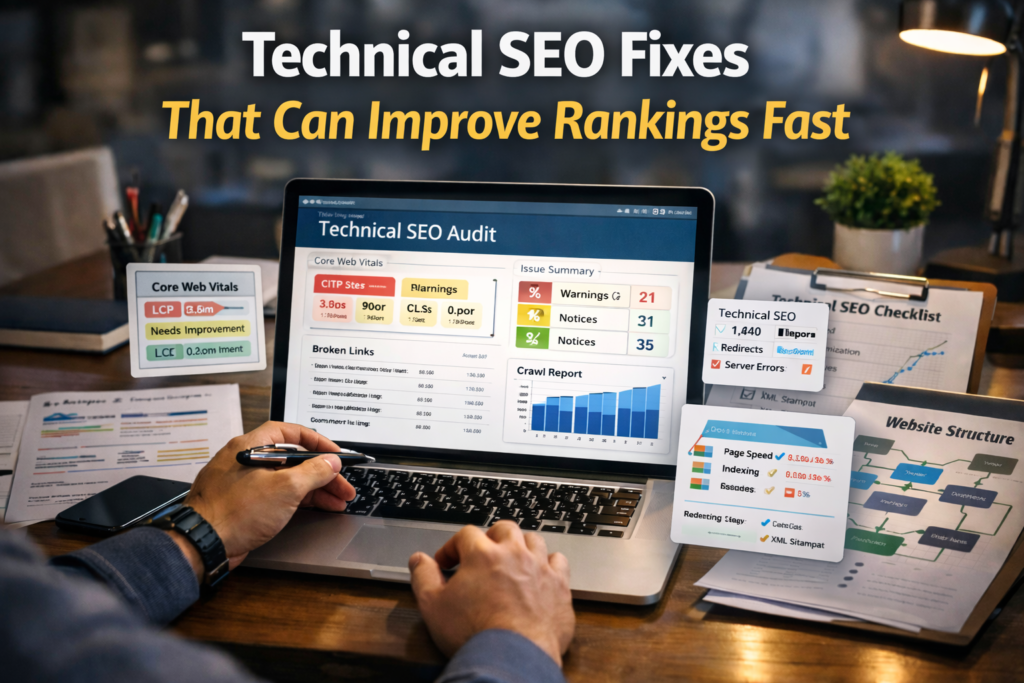
Site Speed & Core Web Vitals (Google’s Real Performance Standard)
Speed is no longer just about loading time.
Google now measures performance through Core Web Vitals.
I always check three key metrics:
LCP (Largest Contentful Paint)
How fast the main content loads.
FID (First Input Delay)
How quickly the site responds when users interact.
CLS (Cumulative Layout Shift)
How stable the page layout feels while loading.
If a page jumps, shifts, or loads slowly, users get frustrated.
And Google notices that.
Improving Core Web Vitals can create real performance improvements because it directly impacts:
-
User experience
-
Engagement signals
-
Trust perception
Mobile Usability Issues
Today, most traffic comes from mobile devices.
But many websites still don’t feel mobile-friendly.
I check:
-
Text readability
-
Button spacing
-
Layout responsiveness
-
CTA visibility
If users struggle to browse on mobile, they leave quickly.
And that sends negative signals to Google.
Internal Linking Fixes + Silo Structure Strategy
Internal linking is not just about connecting pages.
It’s about building structure.
There are two common types of website structures:
Flat Structure (Weak)
Everything is randomly connected.
No clear hierarchy.
This confuses Google.
Silo Structure (Strong)
Content is grouped by category.
Example:
SEO Services
→ Technical SEO
→ On-Page SEO
→ Local SEO
→ SEO Audit
Blog posts support these service pages.
This creates strong topical clarity.
Google understands:
-
What the site is about
-
Which pages are important
-
How topics connect
Whenever I find a flat structure, I slowly convert it into a silo structure.
This improves crawl understanding and authority flow.
The 404 & 301 Redirect Strategy (Hidden Ranking Booster)
This is one of the fastest technical wins.
Many websites delete old pages over time.
But here’s the problem:
Those pages may still have backlinks.
When deleted pages show 404 errors:
You lose link authority.
But here’s what I do:
I find old pages with backlinks and redirect them using 301 redirect to a relevant new page.
This helps:
-
Recover lost link juice
-
Pass authority to active pages
-
Improve ranking signals
This is a classic technical SEO fix that many people ignore.
But it can bring back lost power.
Duplicate Content Fix Using Canonical Tags
Duplicate content creates confusion.
Google may not know:
Which version of a page is the original?
So ranking power gets divided.
To solve this, I use Canonical Tags.
This tells Google:
“This is the main version of the page.”
I use canonical tags especially when:
-
Similar pages exist
-
URL variations exist
-
Filter pages create duplicates
This prevents ranking dilution.
Structured Data & Schema Markup
Schema helps Google understand context.
For service websites, I check:
-
Local Business schema
-
Service schema
-
Review schema
-
FAQ schema
Schema doesn’t directly increase rankings.
But it improves:
-
Understanding
-
Visibility
-
Rich result opportunities
XML Sitemap Optimization
A sitemap helps Google discover pages faster.
I often find:
-
Missing sitemaps
-
Outdated sitemaps
-
Important pages not included
Fixing sitemap issues improves crawl efficiency.
Real Example From a Technical Fix
In one project, I found:
-
Good content
-
Targeted keywords
-
Strong service pages
But rankings were unstable.
After deep technical analysis, I found:
-
Broken internal links
-
Slow mobile performance
-
Old deleted pages with backlinks
After fixing:
-
Speed improved
-
301 redirects restored link power
-
Crawl behavior improved
Over time, rankings became more stable.
Quick Technical Wins I Always Look For
Here are the fastest-impact fixes:
-
Remove noindex from important pages
-
Fix broken links
-
Improve Core Web Vitals
-
Add internal linking
-
Apply canonical tags
-
Recover link juice via 301 redirects
These don’t replace long-term SEO.
But they remove the barriers.
Why Technical SEO Builds Trust
Google wants to recommend reliable websites.
A technically strong site signals:
-
Professionalism
-
Stability
-
Structure
-
Consistency
And trust plays a huge role in rankings.
Final Thoughts
Technical SEO is often invisible.
But it quietly affects everything.
When technical issues exist:
-
Google struggles to understand your site
-
Crawling becomes inefficient
-
Authority signals weaken
When technical health improves:
-
Structure becomes clearer
-
Pages become easier to crawl
-
Content becomes easier to trust
And that’s when rankings start moving.
Conclusion
If your website has good content but slow growth, don’t only focus on adding more articles.
Sometimes, the fastest improvements come from fixing what’s already there.
Technical SEO removes the hidden barriers.
And once those barriers are gone, everything else starts working better.
That’s why I always check technical health first — before expecting real SEO growth.