Introduction: The Silent Problem Most Local Businesses Face
You check your website analytics and notice something interesting.
People are visiting your site.
Traffic is coming in.
Local users are finding you.
But there’s one problem.
They don’t call.
They don’t message.
They don’t book.
They just visit… and leave.
This is one of the most frustrating situations for any local business owner. You’ve already done the hard part — people are discovering your website. They are searching for services in your area. They are landing on your pages.
But they are not turning into clients.
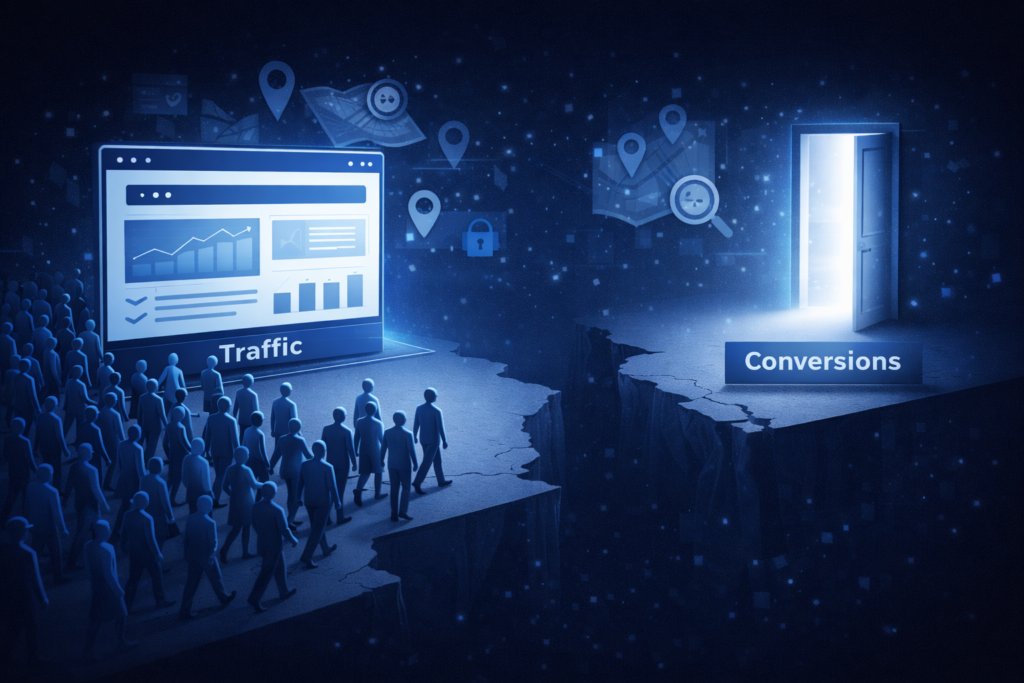
And that gap between a visitor and a customer is where most websites struggle.
This issue is much more common than people think. Many service websites receive local traffic daily but still fail to generate real inquiries. The problem is not always about rankings. In fact, in many cases, ranking is not the issue at all.
The real issue is conversion.
If your website is getting local visitors but not getting calls, bookings, or messages, something is blocking trust, clarity, or action.
In this article, we’ll break down exactly why local customers visit your site but don’t convert, what mistakes usually cause it, and how to fix them step by step.
The Reality: Traffic Alone Does Not Build a Business
Many people believe that if a website ranks and gets traffic, customers will automatically come.
But that’s not how it works.
Traffic only means visibility.
Conversion means trust.
And trust is what turns visitors into clients.
Local customers are not just browsing. They are searching with intent. They want:
-
A solution
-
A reliable service
-
Someone they can trust nearby
When they land on your website, they quickly decide:
-
Is this business real?
-
Do they understand my problem?
-
Can I trust them?
-
Should I contact them?
These decisions happen in seconds.
If your website fails to answer these questions clearly, visitors leave — even if they found you through Google.
Reason #1 – Your Website Feels Generic
This is one of the biggest reasons local visitors don’t convert.
Many service websites look almost the same.
They say things like:
-
“We provide the best service”
-
“We are experts”
-
“We deliver quality work”
But they don’t say anything specific.
When a local customer lands on your site, they are not just looking for a service. They are looking for relevance.
They want to feel like:
“This business understands my area, my needs, and my situation.”
If your content feels generic, visitors don’t feel connected.
They may think:
-
Is this business even local?
-
Do they actually serve my area?
-
Are they experienced?
Without local clarity, trust drops immediately.
Reason #2 – Weak First Impression
Your homepage or service page has a few seconds to make an impression.
If the design looks outdated, cluttered, or confusing, visitors lose confidence.
People judge a business by its website.
They look for:
-
Clean layout
-
Professional feel
-
Easy navigation
-
Clear message
If the site looks messy or hard to understand, they assume the service may also be unprofessional.
Even if your service is excellent, the website creates the first perception.
And perception drives decisions.
Reason #3 – No Clear Local Identity
Local customers want to feel like you are part of their community.
But many websites don’t clearly show where they operate.
They might list services, but not locations.
This creates confusion.
A visitor may wonder:
-
Do they serve my city?
-
Are they nearby?
-
Are they familiar with my area?
Without local signals, people hesitate to contact.
Adding location clarity is not just for SEO.
It’s for trust.
When users see their city mentioned naturally, they feel more comfortable.
Reason #4 – The Page Talks About the Business, Not the Customer
Many service pages focus too much on:
-
Company history
-
Skills
-
Experience
But forget to talk about the customer’s problems.
Local visitors are not thinking about your business first.
They are thinking about their own situation:
-
Their issue
-
Their urgency
-
Their concern
-
Their goal
If your content doesn’t reflect their needs, they don’t feel understood.
And when people don’t feel understood, they don’t convert.
Reason #5 – No Strong Reason to Take Action
Sometimes the website looks good.
The service sounds professional.
But still, no one contacts.
Why?
Because there is no clear reason to act.
Visitors need direction.
They should clearly see:
-
What to do next
-
How to contact
-
Why they should choose you
If the page just gives information but no clear path, people leave.
Not because they’re not interested.
But because they’re unsure.
Reason #6 – Trust Signals Are Missing
Local customers are careful.
They want reassurance before contacting a business.
They look for:
-
Reviews
-
Testimonials
-
Real results
-
Clear communication
If your site has none of these, people hesitate.
Even small trust elements can make a big difference.
Because local decisions are emotional.
People want to feel safe choosing you.
Reason #7 – Slow or Confusing User Experience
If your site is slow, people leave.
If navigation is confusing, people leave.
If information is hard to find, people leave.
Local customers often search quickly.
They want answers fast.
If the experience feels difficult, they move to the next option.
And there are always other options.
Reason #8 – Your Service Page Feels Too Technical
Sometimes websites try too hard to sound professional.
They use:
-
Complex terms
-
Technical language
-
Long explanations
But local visitors want simplicity.
They want to quickly understand:
-
What you do
-
How you help
-
What happens next
If the message feels complicated, people disconnect.
Simple language builds clarity.
Clarity builds trust.
Reason #9 – No Emotional Connection
People don’t choose local services based only on logic.
They choose based on comfort.
They want to feel:
-
Safe
-
Understood
-
Confident
If your website feels cold, robotic, or distant, conversion drops.
Even small human touches help:
-
Friendly tone
-
Relatable examples
-
Clear understanding of problems
These make your site feel real.
Reason #10 – Traffic Intent Doesn’t Match Your Offer
Sometimes local visitors come from searches that are not ready to convert.
For example:
They might be researching.
Comparing.
Learning.
But your page pushes immediate action.
This mismatch creates friction.
The page should guide visitors step by step — not pressure them.
What Actually Converts Local Visitors Into Clients?
Conversion happens when three things come together:
1. Clarity
Visitors understand instantly:
-
What you offer
-
Where you operate
-
Who you help
2. Trust
They feel confident:
-
You are real
-
You are experienced
-
You are reliable
3. Comfort
They feel:
-
Safe contacting you
-
Confident choosing you
When these three elements are strong, conversion increases naturally.
The Role of Service Page Structure
A well-structured service page makes a big difference.
It should clearly explain:
-
The problem
-
The solution
-
The process
-
The benefits
-
The next step
Without structure, visitors feel lost.
With structure, they feel guided.
And guided visitors are more likely to take action.
How Local Trust Builds Over Time
Local trust doesn’t happen instantly.
It grows through consistency.
When Google sees that:
-
Your content is focused
-
Your site is active
-
Your pages are clear
It slowly sends more relevant local traffic.
And when visitors find clarity and confidence on your site, conversion improves.
Small Changes That Can Improve Conversions
You don’t always need a full redesign.
Even small improvements can help:
-
Clearer headlines
-
Better structure
-
Simple language
-
Stronger local signals
Often, the problem is not the service.
It’s how the service is presented.
Why Some Websites Convert Better Than Others
Two businesses can offer the same service.
Both may rank.
Both may get traffic.
But one gets clients.
The other doesn’t.
The difference is usually:
-
Better communication
-
Clearer positioning
-
Stronger trust
Conversion is about connection.
The Hidden Gap Most Website Owners Don’t See
Many business owners focus only on ranking.
They track:
-
Traffic
-
Impressions
-
Keywords
But they don’t analyze behavior.
They don’t ask:
-
Where do visitors stop reading?
-
What confuses them?
-
Why do they leave?
This gap is where conversions are lost.
When Structure Meets Strategy
Local conversion improves when:
-
SEO brings the right audience
-
Structure guides them clearly
-
Trust elements support decisions
This combination turns visits into inquiries.
The Importance of Understanding Visitor Psychology
Local customers often arrive with hesitation.
They may be comparing multiple businesses.
They may be unsure whom to trust.
Your website should make the decision easier.
Not harder.
The Role of Consistency
Consistency builds confidence.
When your website shows:
-
Clear focus
-
Stable messaging
-
Professional structure
Visitors feel safer.
And safety leads to action.
Conclusion: Traffic Is Only Step One
If your site is getting local visitors but not getting clients, it doesn’t mean SEO failed.
It means conversion needs attention.
Traffic brings people.
Trust keeps them.
Clarity converts them.
Local customers don’t need more information.
They need reassurance.
They need to feel:
-
This business understands me
-
This business is nearby
-
This business can help
Once that feeling is created, conversion becomes natural.
And when conversion improves, your website stops being just a digital presence — and starts becoming a real growth engine.
That’s when local SEO begins to show its true value.