When people talk about SEO authority, they usually talk about backlinks.
And yes, backlinks matter.
They bring trust from other websites.
They bring visibility.
They bring ranking power.
But there’s another powerful factor that many websites completely ignore.
Internal linking.
No outreach.
No guest posting.
No waiting months.
Just smart connections inside your own website.
And the impact can be massive.
Internal linking is not just about linking one page to another.
It’s about:
-
Passing authority
-
Helping Google understand structure
-
Strengthening important pages
-
Building topical depth
-
Guiding users naturally
I’ve personally seen websites improve rankings just by fixing internal links — without publishing new content or building backlinks.
In this article, I’ll explain deeply how internal linking builds authority and why it’s one of the strongest long-term SEO foundations.
What Is Internal Linking (In Simple Terms)
Internal linking means connecting one page of your website to another page within the same website.
For example:
-
A blog post linking to a service page
-
A service page linking to a related service
-
A guide linking to a deeper article
It sounds simple.
But internally, this creates a powerful structure.
And Google pays close attention to that structure.
Because internal links help Google understand:
-
Which pages matter most
-
Which pages support others
-
What topics your site covers
-
How authority flows across the website
Without internal linking, your pages exist — but they feel disconnected.
Why Internal Linking Is So Powerful for SEO
Many people focus only on backlinks.
But here’s something important:
Backlinks bring authority into your website.
Internal links distribute that authority across your pages.
This distribution is often called:
Link Juice Flow
If your internal linking is weak:
-
Authority stays stuck on a few pages
-
Important pages remain weak
-
Google struggles to understand structure
But when internal linking is strong:
-
Authority spreads naturally
-
Pages support each other
-
Structure becomes clearer
-
Rankings improve over time
How Google Understands Authority Through Internal Links
Google doesn’t just read content.
It studies relationships.
When one page links to another, Google sees it as a signal:
-
This page is important
-
This topic is connected
-
This website has structure
The more relevant internal links a page receives, the more important it appears.
Think of internal links as recommendations inside your own website.
Contextual Linking vs Navigation Linking
Not all internal links are equal.
There are two main types.
Contextual Links (Most Powerful)
These are links placed inside content.
For example:
Inside a blog paragraph, linking to a service page.
These are very powerful because:
-
They are surrounded by relevant text
-
They help Google understand context
-
They feel natural
-
They pass stronger topical signals
Navigation Links (Less Powerful)
These include:
-
Menu links
-
Footer links
-
Sidebar links
They are useful for structure.
But contextual links inside content usually carry stronger SEO value.
Because they show real topic relevance.
This is why I always focus on smart placement — not just linking randomly.
The Biggest Mistake Most Websites Make
Many websites publish content… but never connect it.
So what happens?
-
Blog posts stay isolated
-
Service pages remain weak
-
Authority doesn’t move
Even great content struggles to rank if it’s not connected.
Internal linking turns separate pages into a strong system.
What Are Orphan Pages and Why They Are SEO Killers?
This is one of the most common problems I find during audits.
Orphan pages are pages that have no internal links pointing to them.
That means:
-
No page connects to them
-
Google finds them harder to discover
-
Google treats them as unimportant
Even if the content is good, Google may ignore them.
Because they are not connected to the site structure.
When I find orphan pages, I immediately:
-
Connect them to related blogs
-
Link them to service pages
-
Add them into the content network
This alone can improve visibility quickly.
Internal Linking Builds Topical Authority
Google loves depth.
If your website talks about a topic repeatedly and connects content around that topic, Google starts seeing you as an authority.
Example:
Main topic: SEO
Supporting topics:
-
Technical SEO
-
On-page SEO
-
Local SEO
-
SEO mistakes
-
SEO audits
Now imagine all these pages linking to each other.
Google starts understanding:
“This website deeply covers SEO.”
That builds topical authority.
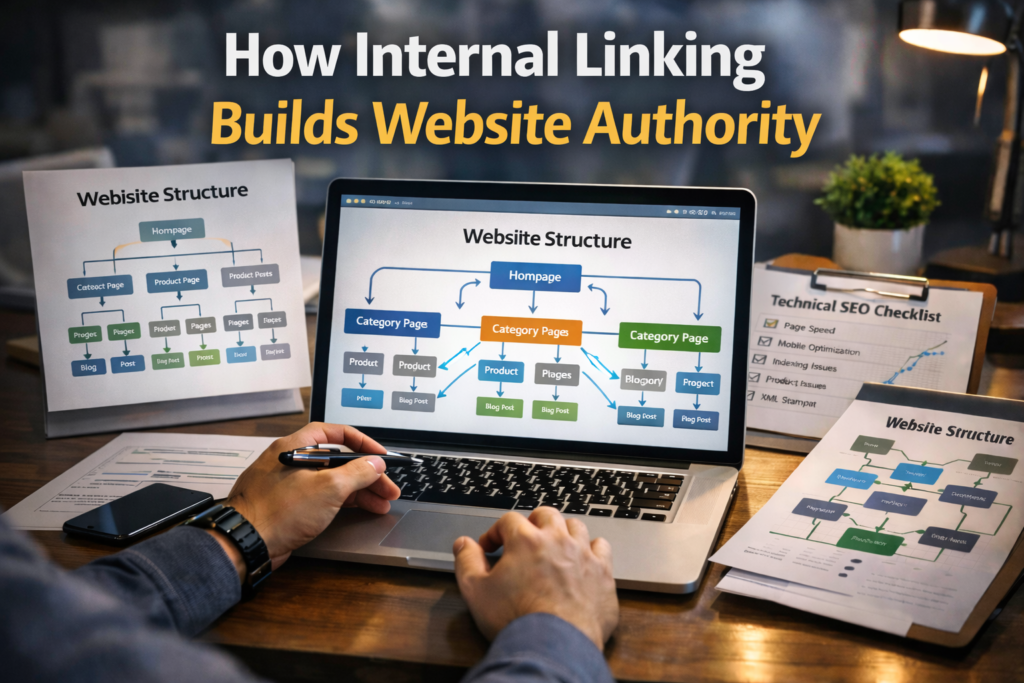
The Power of the Pillar-Cluster Model
One of the strongest internal linking models is called the Pillar-Cluster model.
It’s simple but very powerful.
Let’s say your main topic is:
Digital Marketing
This becomes your Pillar Page.
Now you create cluster pages like:
-
SEO
-
Facebook Ads
-
Email Marketing
-
Content Marketing
Each cluster page links back to the pillar.
And the pillar links to all clusters.
This creates a strong authority network.
When multiple pages point toward one main page, the pillar page becomes extremely strong.
Its authority grows faster.
And Google clearly understands:
“This is the main topic.”
Silo Structure: The Smart Way to Link
Another strong model is silo structure.
This means grouping content by category.
Example:
SEO Services
→ Technical SEO
→ On-page SEO
→ Local SEO
→ SEO Strategy
Each page supports the main topic.
This creates strong topical clarity.
Google understands:
-
What the site is about
-
Which pages are most important
-
How topics connect
Flat Structure vs Strong Structure
Some websites use a flat structure.
Everything is linked randomly.
No category focus.
No hierarchy.
This creates confusion.
A strong structure looks like:
-
Main topic page
-
Supporting pages
-
Related blog posts
All connected logically.
This clarity builds authority faster.
Internal Linking Helps Google Crawl Better
Google crawls websites through links.
If a page has no links pointing to it:
Google may not discover it easily.
Or it may treat it as less important.
But when pages are connected well:
-
Crawling becomes easier
-
Discovery becomes faster
-
Indexing becomes smoother
Internal Links Strengthen Service Pages
This is very important for service websites.
Your service pages should be your strongest pages.
But many websites make this mistake:
They publish blogs… but never link to services.
So what happens?
-
Blogs get traffic
-
Services stay weak
-
Conversions stay low
When blogs link to services:
Authority flows.
Relevance increases.
Trust improves.
Anchor Text: A Small Detail With Big Impact
Anchor text is the clickable part of a link.
For example:
“Learn more about our technical SEO services”
Google reads anchor text to understand context.
So I always use:
-
Natural text
-
Relevant words
-
Clear meaning
Not spammy repetition.
How Internal Linking Improves User Experience
Internal links are not only for Google.
They help users too.
They guide visitors to:
-
Related information
-
Deeper explanations
-
Services they may need
This increases:
-
Time on site
-
Page views
-
Engagement
And Google notices these signals.
Audit Tip: How I Find Internal Linking Gaps
When I audit a website, I don’t guess.
I use tools to find real gaps.
I often use:
-
Google Search Console → Internal Links report
-
Screaming Frog → To find orphan pages and link depth
These tools help me see:
-
Which pages have no links
-
Which pages are getting too many links
-
Which pages are weak
This makes internal linking optimization more precise and professional.
Internal Linking Supports New Pages
When you publish a new page, it starts with zero authority.
But if strong pages link to it:
It gains strength faster.
This is one of the fastest ways to help new content grow.
Common Internal Linking Mistakes I See
During audits, I often find:
-
Orphan pages
-
No links to service pages
-
Random linking
-
Too many links in one section
-
Broken internal links
Fixing these can improve structure quickly.
My Simple Internal Linking Strategy
Here’s my basic approach:
-
Identify main service pages
-
Link to them from relevant blogs
-
Connect related blog posts
-
Build topic clusters
-
Fix orphan pages
-
Strengthen pillar pages
This creates a natural authority flow.
Internal Linking vs Backlinks
Backlinks bring authority from outside.
Internal links spread authority inside.
You need both.
But internal linking is something you fully control.
And that makes it powerful.
Real Impact of Strong Internal Linking
When internal linking improves, you may notice:
-
Better indexing
-
Stronger service pages
-
Clearer site structure
-
More stable rankings
It’s not always instant.
But it’s steady and long-term.
Final Thoughts
Internal linking is one of the most underrated SEO strategies.
It doesn’t look exciting.
It doesn’t feel like a big change.
But over time, it quietly builds authority.
It helps Google understand:
-
Your structure
-
Your topics
-
Your priorities
And when Google understands your site better, trust grows.
Conclusion
You don’t always need more backlinks.
Sometimes, you just need better connections inside your own website.
Internal linking turns your website from a collection of pages into a powerful system.
A system that supports:
-
authority
-
structure
-
visibility
-
long-term growth
And the best part?
You control it completely.