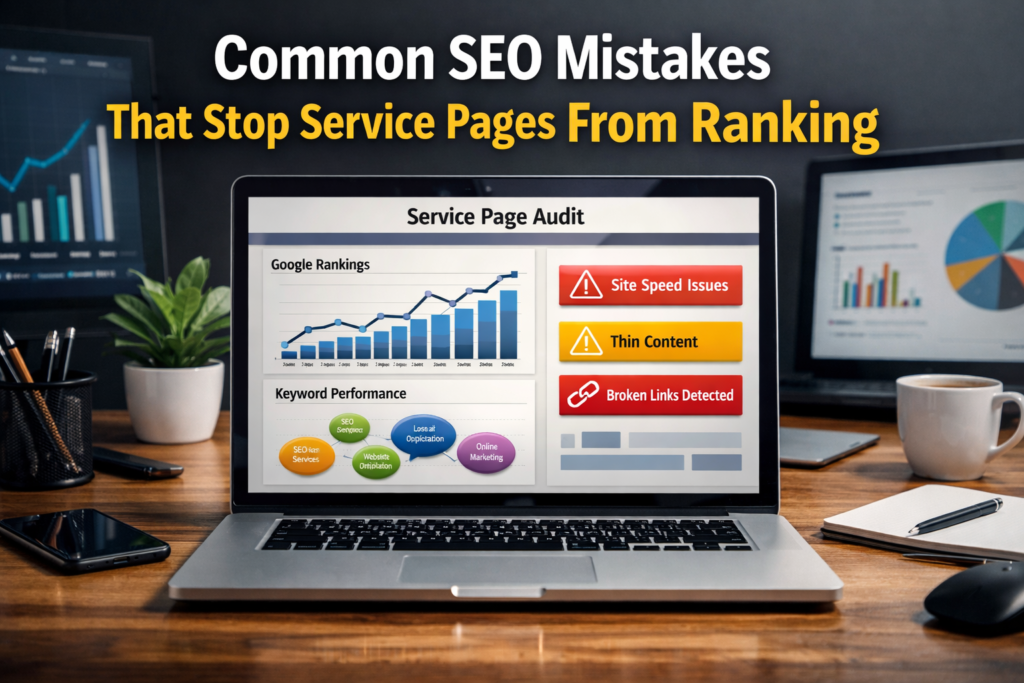
Introduction: The Real Reason Service Pages Stay Invisible
One of the most frustrating situations for any service business owner is this:
You have a clean website.
You clearly explain your service.
You’ve added keywords.
You’ve even done some SEO.
But your service page still isn’t ranking.
Weeks pass.
Then months.
And nothing changes.
No visibility.
No traffic.
No leads.
At this point, most people assume one of two things:
“Maybe the competition is too strong.”
“Maybe SEO just doesn’t work anymore.”
But in reality, most service pages don’t fail because of competition. They fail because of small SEO mistakes that quietly block Google from understanding, trusting, and ranking the page.
These mistakes are often invisible to business owners. The page looks fine. The content looks good. But under the surface, something is missing.
And when something important is missing, Google hesitates.
In this article, we’ll go deep into the most common SEO mistakes that stop service pages from ranking — and why fixing them can completely change the growth direction of a website.
Why Service Pages Are Harder to Rank Than Blog Posts
Before we talk about mistakes, it’s important to understand something many people don’t realize.
Service pages are harder to rank than blog posts.
Blog posts can rank because they answer questions. They provide information. They educate.
But service pages must do more.
They need to:
-
Show expertise
-
Build trust
-
Match strong commercial intent
-
Compete with established businesses
Google treats service pages differently because people searching for services are closer to making decisions. That means Google must be extra careful about what it shows.
So if your service page is not ranking, it usually means Google is not fully confident about something yet.
Let’s explore what might be causing that.
Mistake #1: Targeting the Wrong Keywords
One of the most common mistakes is targeting keywords that don’t match service intent.
Many service pages are optimized for:
-
Broad keywords
-
Informational terms
-
General industry phrases
But people searching for services use very specific language.
For example, there is a big difference between:
-
“What is SEO”
and -
“SEO expert for small business”
The first is informational.
The second is service intent.
If your service page is built around general keywords instead of buyer-intent keywords, it may get impressions but not strong rankings.
Google tries to match pages with the most relevant intent. If your page doesn’t clearly signal that it is meant for people looking to hire a service, it may get pushed aside.
Mistake #2: Weak Page Structure
A service page must be extremely clear.
Within the first few seconds, a visitor should understand:
-
What service you offer
-
Who it is for
-
What problem it solves
-
Why they should trust you
But many service pages are structured poorly.
They start with long introductions.
They talk about general topics.
They don’t clearly explain the value.
When structure is weak, two problems happen:
Google struggles to understand the page.
Visitors struggle to trust the page.
A strong structure helps both.
Clear headings, focused sections, and direct messaging make it easier for search engines and users to understand what your page is really about.
Mistake #3: Not Solving a Clear Problem
Service pages that perform well always revolve around problems.
But many pages talk too much about the business and not enough about the client.
They say things like:
“We provide high-quality services.”
“We are experienced.”
“We offer professional solutions.”
These statements are generic. They don’t connect emotionally or logically.
Google prefers pages that clearly address real user problems.
And visitors trust pages that make them feel understood.
If your page doesn’t strongly connect with a specific pain point, it may not feel relevant enough to rank well.
Mistake #4: Thin or Surface-Level Content
Another major issue is shallow content.
Some service pages are too short.
Some repeat the same ideas.
Some don’t explain the process.
Google prefers depth.
It wants to see:
-
Clear explanations
-
Real detail
-
Helpful guidance
-
Strong topic coverage
This doesn’t mean stuffing the page with words. It means providing enough information so Google understands that the page truly covers the topic.
When content feels too light, Google may assume the page doesn’t offer enough value compared to competitors.
Mistake #5: Weak Internal Linking
Internal linking is one of the most underrated parts of SEO.
Many service pages exist alone, disconnected from the rest of the site.
No supporting blogs link to them.
No related content strengthens them.
This creates a weak authority signal.
When internal links support a service page, Google sees it as important. It understands the topic better and can see the relationship between content.
Without internal linking, a service page can feel isolated.
And isolated pages rarely become strong pages.
Mistake #6: Confusing Page Intent
Sometimes a page tries to do too many things at once.
It tries to:
-
Explain the service
-
Teach SEO basics
-
Sell multiple services
-
Target multiple audiences
This creates confusion.
Google prefers pages with one clear purpose.
If a service page tries to target too many topics, Google may struggle to decide what the page should rank for.
Clarity builds strength.
One page.
One service.
One intent.
This makes ranking easier.
Mistake #7: No Trust Signals
Trust plays a huge role in ranking service pages.
Think about it from Google’s perspective.
If someone searches for a service, Google wants to show a page that feels reliable.
Trust signals can include:
-
Clear explanations
-
Consistent content
-
Professional layout
-
Helpful insights
-
Logical structure
Even without showing testimonials or credentials, a page can feel trustworthy if it is written clearly and focuses on helping.
When trust is missing, rankings often struggle.
Mistake #8: Poor Technical Foundation
Sometimes the issue has nothing to do with the content.
It’s technical.
Slow loading speed, poor mobile experience, messy structure, or crawl confusion can quietly block rankings.
These problems are often invisible.
The page looks fine.
But Google may struggle to read it properly.
Technical clarity is part of trust.
When a website is clean, fast, and easy to crawl, Google feels more confident about ranking its pages.
Mistake #9: Expecting Quick Results
This is more common than people realize.
Many business owners publish a service page and expect it to rank within weeks.
But service page SEO takes time.
Google needs to:
-
Discover the page
-
Understand the topic
-
Compare it with others
-
Observe how users respond
If a page is new, it may take time to build trust and authority.
Impatience often leads to constant changes, which can slow progress further.
Consistency is more powerful than quick reactions.
Mistake #10: Ignoring Topical Authority
A single service page rarely ranks on its own.
It needs support.
When a website has related content around the same topic, something interesting happens.
Google begins to see the site as a specialist.
For example, a service page becomes stronger when supported by blog posts about:
-
Problems related to the service
-
Solutions
-
Industry insights
-
Common challenges
This builds topical authority.
And authority helps rankings grow naturally.
The Hidden Truth: Small Mistakes Add Up
Here’s something many people don’t notice.
One small mistake may not stop a page from ranking.
But several small mistakes together create a barrier.
Weak structure + thin content + poor linking + unclear intent = low confidence.
When confidence is low, Google holds back.
That’s why many service pages stay stuck on page 3, 4, or beyond.
They are not bad pages.
They are just missing key signals.
What Happens When These Mistakes Are Fixed
When service pages are cleaned up and improved, changes often happen gradually.
Google starts understanding the page better.
Crawling becomes easier.
Clarity improves.
Over time, the page becomes more stable.
This doesn’t always create instant ranking jumps. But it builds momentum.
And momentum leads to long-term growth.
Why Service Page SEO Requires a Different Mindset
Service page SEO is not just about keywords.
It’s about positioning.
It’s about clarity.
It’s about trust.
A strong service page speaks directly to a problem, explains the solution, and feels focused and reliable.
When Google sees that, it becomes more confident.
And when users feel that, they stay longer and engage more.
Both signals matter.
Conclusion: Ranking Starts With Clarity
If your service page is not ranking, it does not always mean something is wrong.
But it often means something is missing.
Maybe the intent is unclear.
Maybe the structure is weak.
Maybe the content is too shallow.
Maybe the page feels isolated.
These are common problems. And they are fixable.
Service page SEO is not about quick tricks. It’s about building a page that feels strong, helpful, and trustworthy from every angle.
When clarity improves, confidence improves.
And when confidence improves, rankings start to follow.
Sometimes the difference between a page that ranks and a page that doesn’t is not a major change.
It’s simply removing the small barriers that were quietly holding it back all along.