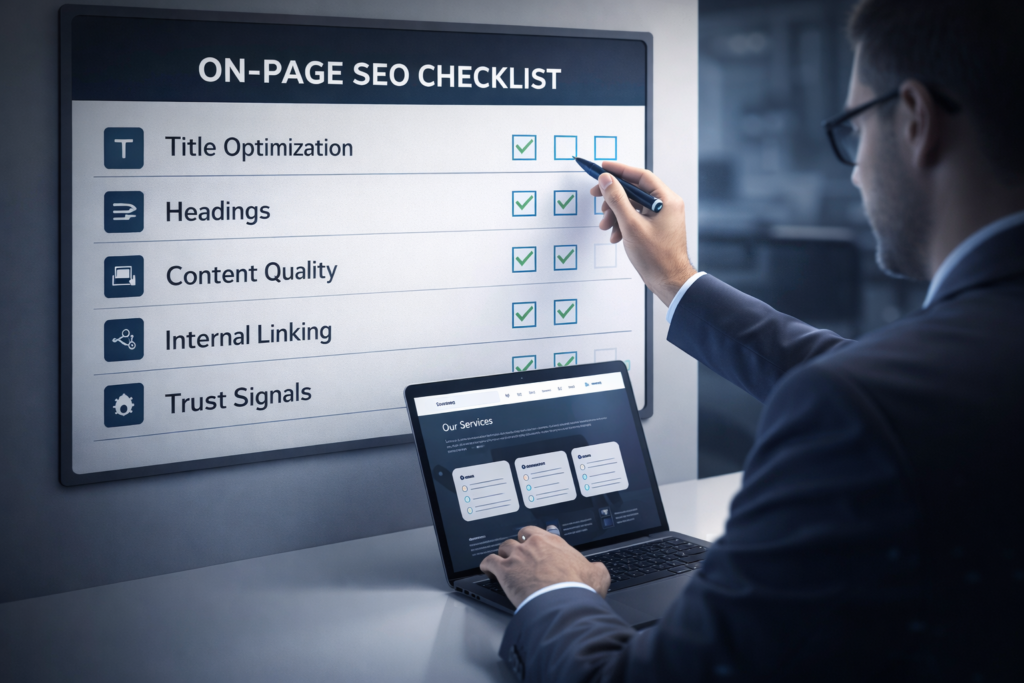
Step-by-Step Process I Use Before Expecting Rankings or Leads
Most service business owners think on-page SEO means only one thing:
Adding keywords.
So they:
-
Add keywords to titles
-
Repeat keywords inside content
-
Publish a few pages
-
Wait for rankings
But nothing happens.
No traffic.
No calls.
No leads.
And then they start thinking:
“SEO doesn’t work.”
But the truth is very different.
On-page SEO is not about keywords.
It’s about making your website:
-
Clear
-
Trustworthy
-
Structured
-
Easy for Google to understand
-
Easy for people to trust
And for service websites, this matters even more.
Because you are not just trying to rank.
You are trying to:
-
Attract the right people
-
Show authority
-
Build trust
-
Turn visitors into clients
In this article, I’m sharing my complete on-page SEO checklist — the exact process I use before expecting rankings, traffic, or leads from a service website.
This is not theory.
This is the same system I follow when optimizing real service websites.
Why On-Page SEO Matters More for Service Websites
E-commerce sites sell products.
Blogs sell information.
But service websites sell trust.
Before contacting a service provider, visitors silently ask:
-
Can I trust this person?
-
Do they understand my problem?
-
Are they experienced?
-
Will they solve my issue?
Your on-page SEO must answer these questions without saying a word.
It must show:
-
clarity
-
expertise
-
professionalism
-
confidence
Because Google ranks trust.
And users convert based on trust.
My Complete On-Page SEO Checklist (Step-by-Step)
I divide my process into 10 critical areas.
Each one plays a direct role in:
-
rankings
-
visibility
-
conversions
-
authority building
Step 1: Understanding Search Intent First (Most Important Step)
Before optimizing anything, I ask:
What is the visitor actually looking for?
If intent is wrong, nothing works.
For service websites, most searches fall into these types:
-
Hire service near me
-
Best service provider
-
Service cost
-
Local service in city
-
Emergency help
So I make sure the page clearly answers:
-
What the service is
-
Who it’s for
-
Where it’s available
-
How to get started
If intent is wrong, even perfect SEO won’t convert.
Step 2: Perfecting the Title Tag
The title tag is one of the strongest ranking signals.
It tells Google:
-
What the page is about
-
Who should see it
And it tells users:
-
Why they should click
My simple structure:
Service + Location + Value
Example mindset:
Not keyword stuffing.
But clarity + intent + benefit.
Step 3: Writing Strong Meta Descriptions
Meta descriptions don’t directly rank.
But they increase clicks.
And more clicks = stronger performance.
A strong meta description should:
-
Explain the problem
-
Offer the solution
-
Show trust
-
Encourage action
I write it like a small ad.
Step 4: H1, H2, H3 Structure Optimization
Google understands content structure through headings.
I always check:
-
Only one H1
-
Logical H2 sections
-
Supporting H3 sub-topics
Headings should explain content, not decorate it.
Step 5: Content Clarity and Depth
This is where real authority is built.
A strong service page must clearly explain:
-
What the service is
-
Who needs it
-
How the process works
-
Common problems
-
Expected outcomes
-
Why choose this provider
When content feels complete, Google trusts it more.
Step 6: Readability Optimization
Google prefers content people actually read.
So I check:
-
Short paragraphs
-
Clear language
-
Natural flow
-
Easy scanning
If users stay longer, rankings get stronger.
Step 7: NLP & Semantic Relevance Check
Modern Google doesn’t rely on keywords alone.
It understands context.
So I check if content naturally includes related topic terms.
Example for Local SEO page:
-
rankings
-
traffic
-
Google Maps
-
visibility
-
local customers
This builds topical relevance and authority.
Step 8: Internal Linking Strategy
Internal links pass authority.
But most websites use them randomly.
I use them to:
-
Connect services
-
Support key pages
-
Guide Google
-
Guide users
This strengthens structure and trust.
Step 9: Image Optimization
Images also send SEO signals.
I check:
-
File names
-
Alt tags
-
Image size
-
Speed impact
Images should support content, not slow it down.
Step 10: Trust Signal Placement
This is where conversions happen.
I make sure pages include:
-
Testimonials
-
Experience indicators
-
Clear contact options
-
Real business information
Because people don’t hire strangers.
They hire people they trust.
On-Page SEO Priority Matrix (Which Tasks I Fix First — My Real Workflow)
One thing most people don’t understand:
Not all on-page tasks have equal impact.
So I always follow a priority system.
🔴 Highest Priority (Fix First)
-
Search Intent alignment
-
Title tag clarity
-
H1 structure
-
Service page content clarity
These create the biggest ranking impact.
🟡 Medium Priority (Fix Next)
-
Internal linking
-
NLP content optimization
-
Readability improvements
-
Trust signals
These improve authority and engagement.
🟢 Final Layer (Polish Stage)
-
Image optimization
-
Meta descriptions
-
Minor heading adjustments
These improve performance and CTR.
This priority matrix helps clients understand:
SEO is not random.
It’s structured.
It’s strategic.
It’s layered.
Real Example From a Service Page Optimization
I once worked on a service page that had:
-
Good keywords
-
Decent content
-
Clean design
But no leads.
After auditing on-page elements, I found:
-
No process explanation
-
No trust elements
-
Weak heading structure
-
No internal links
After improving:
-
content clarity
-
structure
-
trust signals
Engagement improved noticeably.
This is the real power of on-page SEO.
Common Mistakes I Always See
During audits, I often find:
-
Keyword stuffing
-
Thin service pages
-
Generic content
-
Weak CTAs
-
Poor structure
And fixing these usually gives faster results than adding more content.
The Golden Rule for Service Pages
Here’s something I always tell clients:
“Google ranks what users love. If your page answers a client’s problem in the first 30 seconds, Google will reward you with visibility.”
This is the core truth of modern SEO.
Clarity wins.
Trust wins.
Helpfulness wins.
How On-Page SEO Impacts Rankings
When on-page SEO is strong:
Google understands:
-
What you do
-
Who you help
-
Where you serve
-
Why you matter
And that builds trust.
Trust builds rankings.
Rankings bring traffic.
Traffic brings clients.
Final Thoughts
On-page SEO is not a one-time task.
It’s a foundation.
It makes your website:
-
Clear
-
Structured
-
Relevant
-
Trustworthy
And when everything aligns:
Google understands your website faster. Users trust you more. And SEO starts bringing real business — not just visitors.