Most people think SEO starts with keywords.
I don’t.
For me, SEO starts with a simple but powerful question: “What is actually stopping this website from growing?”
Because here’s the truth most people don’t realize:
You can publish content.
You can add keywords.
You can even build backlinks.
And still… nothing happens.
No rankings.
No leads.
No real traffic.
And in most cases, the reason is simple:
Nobody checked the foundation. That’s why before I touch anything — content, keywords, links — I always start with a deep website audit.
Not a surface-level check.
A real audit.
One that helps me understand:
-
What Google sees
-
What users experience
-
What is broken
-
What is missing
-
What is holding the site back
This article explains my exact process.
This is not theory. This is the same audit system I use for real client projects before starting SEO work.
Why a Website Audit Is the First Step in Real SEO
SEO is not magic.
It’s not about adding keywords and hoping for the best.
It’s about removing blockers first.
In most websites, problems hide silently:
-
Important pages are noindexed
-
Internal links are broken
-
Structure is confusing
-
Content doesn’t match intent
-
Technical issues reduce trust
And until these problems are fixed, rankings stay stuck.
A website audit helps me answer 5 critical questions:
-
Can Google properly crawl the site?
-
Can Google understand the structure?
-
Is the content aligned with search intent?
-
Is the site technically strong?
-
Can traffic convert into leads?
Real Example From My Audit Work
Last month, I audited a service business website.
They were publishing blogs regularly.
But traffic was not growing.
When I checked the site, I discovered something shocking: All blog pages had noindex tag active. That means Google was not indexing them at all. One small technical setting. That’s it. After removing the noindex tag:
Within weeks:
-
More pages got indexed
-
Traffic started growing
-
Visibility increased
This is why audits matter. Sometimes one small issue blocks everything.
My Complete Website Audit Process (Step-by-Step)
I divide my audit into 7 major sections.
Each section helps me understand the website from a different angle.
Step 1: I Start With the Business Goal (Not SEO)
Before checking anything technical, I ask:
-
What service does this business sell?
-
Who is their target customer?
-
Which city/location do they serve?
-
What type of leads do they want?
-
What is the main conversion action?
Because SEO without business clarity becomes random.
If I don’t understand the goal, I cannot build the right strategy.
Step 2: Indexing & Crawl Check
(Can Google Even See This Website?)
This is the first technical layer.
I check:
Site Index Test
I search:
site:domain.com
This shows:
-
How many pages are indexed
-
If service pages are missing
-
If junk pages are indexed
If I only see homepage results, it’s a major warning sign.
Robots.txt Review
I check if important sections are blocked.
Common problems I find:
-
/services/ blocked
-
/blog/ blocked
-
CSS/JS blocked
Noindex Tag Audit
Many developers forget to remove noindex after site launch.
I verify:
-
Service pages are indexable
-
Blog posts are indexable
-
Category pages are indexable
This alone can fix major ranking issues.
Step 3: Website Structure Analysis
(Can Google Understand the Website?)
Google doesn’t read websites like humans. It understands relationships.
So I check:
Navigation Clarity
Is the menu structured?
Good structure:
Home
Services
Locations
Blog
About
Contact
Bad structure:
Random pages
Too many menu items
No clear hierarchy
URL Structure
I check if URLs explain page meaning.
Good:
example.com/seo-services/dallas
Bad:
example.com/page?id=2837
Content Silos
I check if pages are grouped logically.
Example structure I expect:
Main Service Page
→ Sub service pages
→ Location pages
→ Blog posts supporting services
If content is scattered, Google gets confused.
Step 4: Technical SEO Health (Deep Expert Level Check)
This is where most website owners don’t understand anything. And this is where SEO experts show their real value. Here’s what I deeply analyze:
Page Speed & Core Web Vitals
I check:
-
LCP
-
CLS
-
Total Blocking Time
-
Mobile performance
Slow websites lose users.
And Real Example: I once audited a site where homepage load time was 7 seconds. After optimization:
Bounce rate dropped significantly.
Schema Markup Check (Very Important)
I verify if the site uses structured data like:
-
Local Business schema
-
Service schema
-
Review schema
-
FAQ schema
Schema helps Google understand:
-
What the business does
-
Where it operates
-
What users say about it
Many websites completely ignore this.
Internal Linking Strategy & Link Juice Flow
I don’t just check links.
I check how authority flows.
I analyze:
-
Which pages get most internal links
-
Which important pages get no links
-
How link equity is distributed
Because internal links pass authority.
This is called “link juice.” If service pages are not getting internal links, they stay weak.
Duplicate Content Detection
I check for:
-
Tag pages
-
Attachment pages
-
Parameter URLs
-
Thin pages
Too many duplicates confuse Google.
Step 5: On-Page SEO Deep Analysis
(Content Intelligence Level Check)
This is where I go deeper than normal audits.
I don’t just check keywords.
I check content intelligence.
Title & Heading Structure
I check:
-
Intent match
-
Clarity
-
Keyword placement
-
Emotional strength
Readability Audit
I check if content is:
-
Easy to read
-
Structured clearly
-
Broken into sections
-
Human friendly
Google values readability more than ever.
NLP & LSI Optimization Check
Modern Google doesn’t rely on keywords only.
It uses Natural Language Processing.
I check if content includes:
-
Related topic words
-
Semantic relevance
-
Contextual depth
Example:
For SEO service page:
It should include words like:
ranking, traffic, Google, structure, audit, content, backlinks.
This builds topical strength.
Step 6: Content Depth & Topical Authority Check
I analyze:
-
Is this site covering its niche deeply?
-
Or just publishing random content?
Authority grows when content supports a core topic.
I look for gaps like:
-
Cost guides
-
Process explanation
-
Common mistakes
-
FAQs
-
Comparison content
These build trust and authority.
Step 7: Conversion & Trust Signal Audit
Traffic alone means nothing.
So I audit like a customer.
I check:
-
Are CTAs clear?
-
Is contact easy?
-
Are reviews visible?
-
Is the business trustworthy?
Common issues I find:
-
Hidden contact buttons
-
Weak trust signals
-
No testimonials
-
Confusing layouts
These reduce leads.
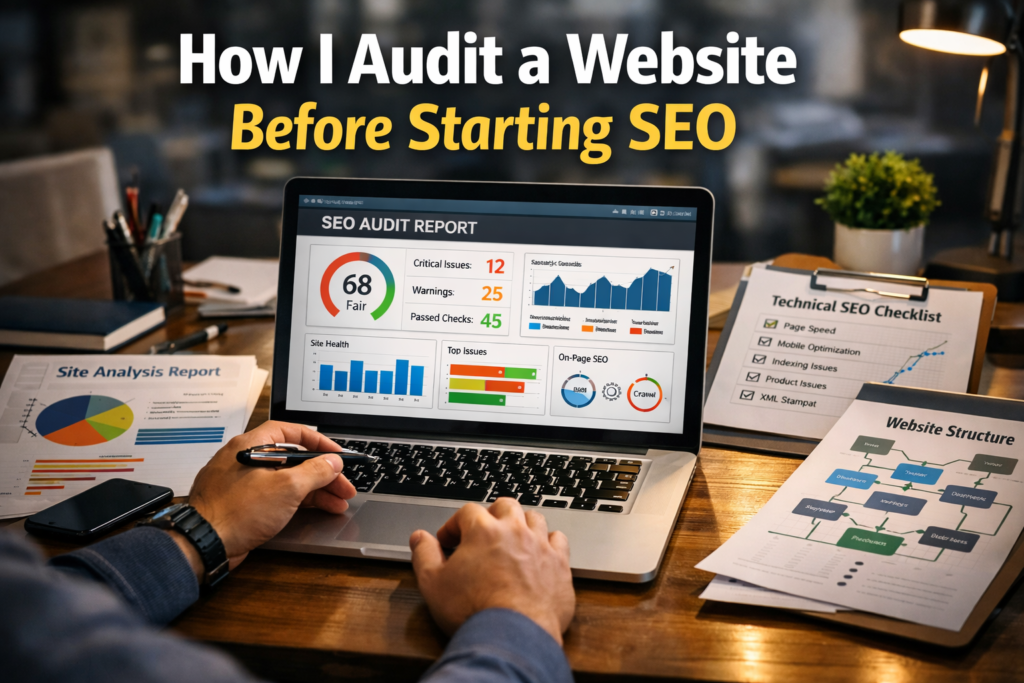
What’s Inside My Audit Report?
(What Clients Actually Receive)
After finishing the audit, I don’t just send a long document.
I create a clear visual roadmap.
Traffic Light System
I classify problems like this:
🔴 RED – Fix Immediately
Major issues blocking rankings
Example:
-
Noindex on pages
-
Broken structure
-
Slow speed
🟡 YELLOW – Needs Improvement
Example:
-
Weak internal linking
-
Thin content
-
Missing schema
🟢 GREEN – Working Well
Example:
-
Clean navigation
-
Good structure
-
Strong pages
This helps clients clearly understand:
What is urgent
What can wait
What is already strong
Final Thoughts
SEO doesn’t start with content.
SEO starts with understanding.
A proper audit shows:
-
What’s broken
-
What’s missing
-
What’s confusing Google
-
What’s stopping growth
And once these problems are fixed:
Everything changes.
Pages index faster.
Rankings improve.
Traffic grows.
Leads increase.
That’s why I never start SEO blindly.
I start by understanding the website first.